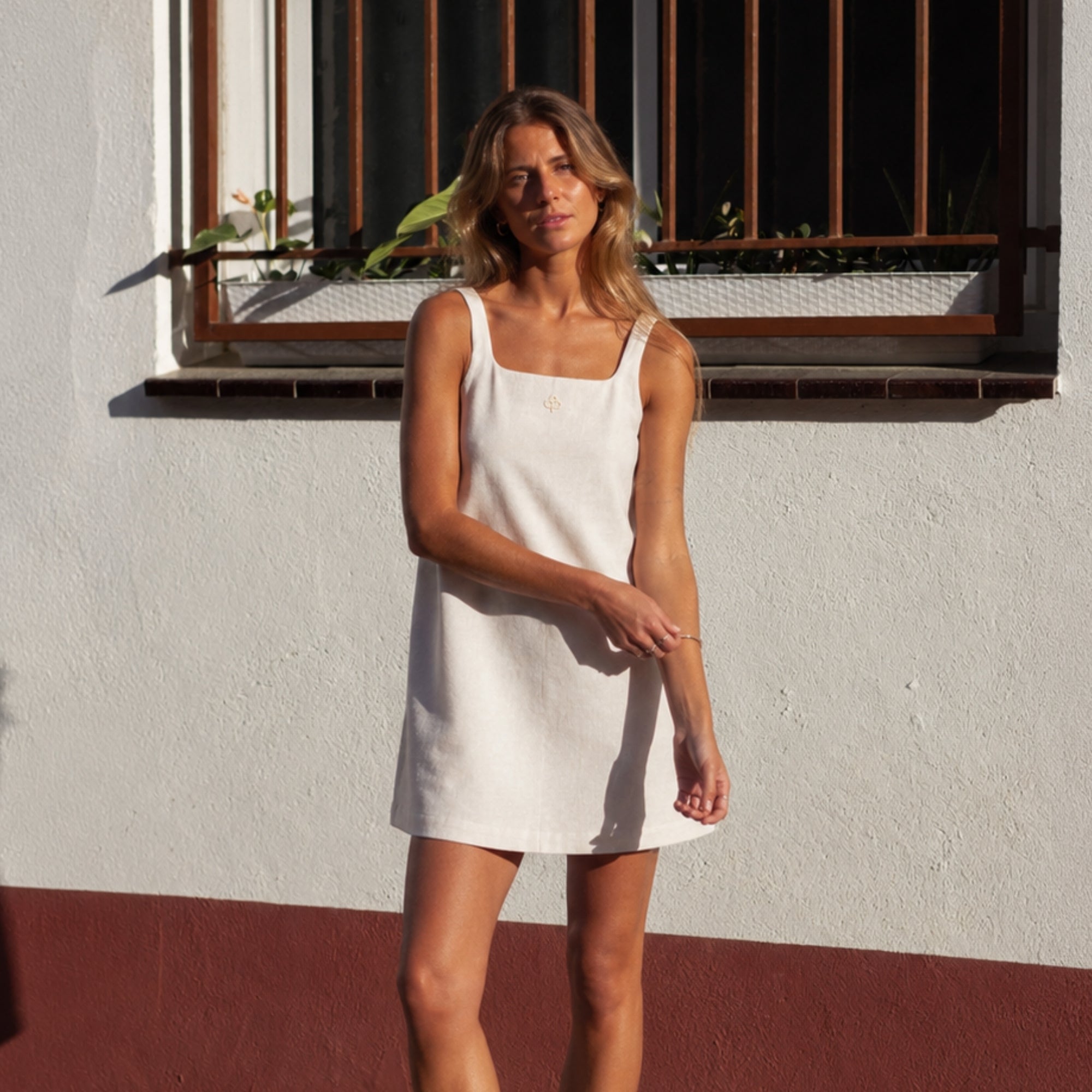
Summer 2025 Results: What Pre-Order Taught Us
Summer 2025 was the first real test of the Pamuuc pre-order model at scale. Not a pilot or a soft launch — a full season of weekly production batches, real demand, real logistics and real feedback from the people who bought the clothes. Here is what we learned.
The numbers
We produced 526 pre-order garments across the summer collection. Dresses and trousers led demand, followed closely by tank tops. Among the garment types that offered colour options, navy emerged as the strongest performer by a significant margin, with S, M and L moving fastest across sizes — though XS and XL both had meaningful order volumes.
For a first season running the model at this level, that volume told us something important: the approach works when the product is desirable and the communication is honest. Customers are willing to wait for a garment made in a weekly batch. They are not willing to wait if the process is opaque or the product feels generic. The two conditions go together.
What pre-order changed about how we work
Pre-order fundamentally changes the relationship between demand and production. In a conventional model, we would have had to estimate demand for each style, colour and size before the season began — and then live with the consequences of those estimates being wrong. Too much of something means discounting or disposing. Too little means missed sales and frustrated customers.
With weekly pre-order, we produced what was confirmed, in the quantities confirmed, in the colours and sizes chosen. We did not cut fabric for garments that might sell. We cut fabric for garments that had already sold.
That shift is not free. Planning must happen earlier, production partners need to maintain a reliable weekly rhythm, and communication with customers has to be consistent and clear from the moment they order. Each of those things takes work. But the alternative — speculative production followed by aggressive selling — creates problems that are harder to undo.
How the weekly rhythm actually felt
Each week followed the same pattern: orders accumulated from Monday, the window closed on Sunday at 23:59, and on Monday morning we compiled the batch and sent it to production. Across the summer, that rhythm became something we could plan around. We knew the rough volume of each batch by Friday or Saturday. We could communicate with production partners early enough to avoid surprises on Monday morning.
Some weeks were busier than others. When a new style launched or a colour became popular, a single week's batch could be substantially larger than the average. Smaller batches in quieter weeks gave production more breathing room and sometimes resulted in dispatch ahead of the 12-day estimate. Larger batches sometimes pressed up against it.
What the rhythm makes clear is that the 12-day estimate needs to be understood as exactly that — an estimate based on a reasonably sized batch. It is not a fixed promise, and we were transparent about that when batches ran longer. The feedback from customers who understood the model was consistently better than from those who had not read the pre-order explanation at checkout. That tells us we need to make that explanation more visible, not more detailed.
What customers told us
The most consistent positive feedback was around three things: fabric feel, garment quality and the honesty of how the project presents itself. People who ordered from us had usually done a little research first — they had read the pre-order page, looked at the transparency commitments, or seen a feature. That level of prior engagement produced customers who were ready for the wait and genuinely happy with the result.
The most useful critical feedback came from trouser fit. Trousers are the most body-variable garment type we make. What fits well at the waist may not work at the hip. What looks right flat on a table sits differently on a body with different proportions. This is a problem that the best size guide in the world can only partially solve. We are working on expanded fit information and, where possible, more photos of garments on bodies with different proportions.
We do not treat criticism as a problem to manage. Specific, honest negative feedback is the most useful information we receive, because it tells us exactly where the garment, the communication or the process is not working as well as it could.
Why local production helped us deliver on this
Running a weekly pre-order model requires production partners who can absorb a variable weekly rhythm and communicate clearly when something needs adjusting. Our Barcelona-area network for cut-and-sew, finishing and embroidery, and our partnership with Sompunt for knitwear, gave us what we needed to do that.
When a weekly batch had an unusual colour combination or a new embroidery layout, we could discuss it directly. When a batch was running close to the 12-day estimate, we knew before it became a problem. When a fabric behaved differently than expected in a particular dye run, we found out quickly enough to act. None of that is guaranteed by local production — but all of it is made more likely when you are working with people you can reach directly and visit when it matters.
For us, local production is not a sustainability claim we put on the website to feel better about ourselves. It is the practical mechanism that makes the pre-order model work the way it should.
What we are refining going forward
Pre-order will continue to be the centre of how we work. But the summer taught us some things we want to improve:
- Pre-order communication at checkout. We want the timeline and the model to be impossible to miss for a customer who has not read the pre-order page. Too much confusion is preventable.
- Trouser fit information. More photos, more measurement context, and possibly a fit note that describes the cut and whom it is likely to suit best.
- Batch size smoothing. Large single-week spikes in volume can stretch the 12-day estimate. We are looking at how we communicate around high-demand weeks.
- Small controlled stock after pre-order. For size exchanges or late orders, a small stock of the most in-demand sizes and styles — kept deliberately limited — may reduce friction without reintroducing the speculative production logic we wanted to avoid.
None of these changes alter the fundamental model. Pre-order from confirmed demand, produced with partners we know, explained honestly from the start. That part is not changing.
Keep exploring
To understand the pre-order model in detail, read the Pamuuc pre-order method. For the broader production and sustainability logic, visit our transparency page. For questions about how ordering and shipping work, visit Shipping and Pre-Order Information.